
Table of Contents
How to Create Cinematic CGI with AI
Discover 5 powerful CGI prompts you can test right now in Midjourney, Leonardo, Kling, Stable Diffusion/Dream Studio and Nano Banana. Learn how each AI interprets cinematic visuals and unlock the secrets of prompt engineering for hyperrealistic results.
When we talk about CGI (Computer-Generated Imagery) in the world of AI art, we are not only referring to movie effects or game design. Instead, we explore how text-to-image models recreate cinematic visuals through carefully crafted prompts. CGI prompts are designed to achieve hyperrealism, atmosphere, and cinematic power.
In this article, I will share five prompt examples that you can test directly. Each one is linked to a different AI platform — from Midjourney to Leonardo, Kling, Stable Diffusion and even emerging spaces like Nano Banana or Recraft. The idea is not just to give you words, but to help you understand why each platform is ideal for each case.
Example 1: Midjourney Prompt – Futuristic Cityscape
CGI Prompt:
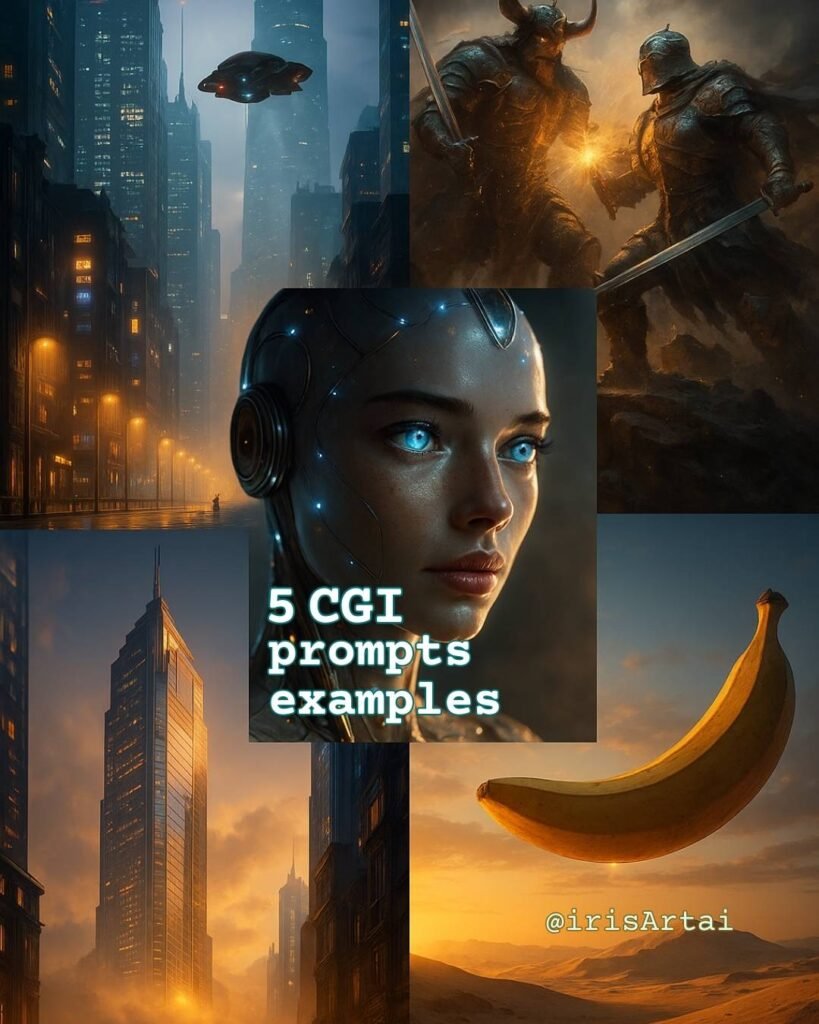
“Futuristic cyberpunk city skyline at night, glowing neon lights, flying cars across the horizon, cinematic wide-angle shot, photorealistic CGI style –ar 9:16 –v 7”
Why test it in Midjourney?
Midjourney v7 is considered the best for composition and atmosphere. Thanks to its community of millions of users, it has become the reference point for cinematic visuals. If you want a vibrant cyberpunk city that feels like a movie scene, this is the place to start.

Example 2: Leonardo Prompt – Epic Fantasy Battle
CGI Prompt:
“Two colossal warriors clashing in a ruined medieval castle, dramatic storm clouds above, cinematic CGI style, ultra-detailed armour, sparks flying, high dynamic range”
Leonardo.ai is one of the most versatile platforms, offering advanced style controls. In scenes with action, armour, and dramatic lighting, Leonardo gives you depth and detail that make the image look like a frame from a fantasy blockbuster.

Example 3: Kling Prompt – Sci-Fi Character Close-Up
Prompt:
“Close-up portrait of an android with human features, glowing mechanical implants, cinematic depth of field, CGI photorealism, ultra high detail, 8K style”
Kling is gaining traction thanks to its ability to generate hyperrealistic characters. Its strength lies in close-ups and portraits, where subtle details such as skin, metal, and cinematic lighting become convincing CGI renders.

Example 4: Stable Diffusion (DreamStudio) – Architectural CGI
Prompt:
“Glass-and-steel futuristic skyscraper emerging from clouds, golden hour lighting, cinematic CGI render, hyperrealistic reflections, architectural photography style”
Stable Diffusion is perfect for architectural renders. DreamStudio allows fine-tuning of technical parameters, so you can achieve photorealistic reflections and lighting effects. It’s a strong choice when you want results close to real-world archive.

Example 5: Nano Banana– Experimental CGI Concept
Prompt:
“Surreal CGI concept: giant floating banana-shaped spaceship hovering over desert landscape, cinematic wide shot, photorealistic lighting, experimental sci-fi style”
Emerging tools such as Nano Banana stand out for their experimental potential. These platforms are ideal if you want to test surreal CGI concepts that might go viral thanks to their originality. Perfect for playful, unexpected ideas.

Final Thoughts
Each platform interprets CGI prompts differently:
- Midjourney excels at atmosphere and cinematic scope.
- Leonardo brings complexity and detail into battle scenes.
- Kling delivers ultra-realistic portraits.
- Stable Diffusion ensures flexibility in architecture and design.
- Nano Banana/Recraft invite you to experiment with surrealism.
Ultimately, the most important lesson is that the same words can generate very different outcomes depending on the model. That is the magic of prompt engineering. So, try these prompts, compare results, and share your creations with the world. Who knows? Your next CGI masterpiece might be born from a single line of text.
That’s all for now about this 5 CGI prompts examples.
I hope you found this post interesting, and I encourage you to share your experiences in the comments below—prompts, details, questions, advice, or whatever you like.
🩷 Thank you for being here today.
Related Content
The Magic of Prompt Engineering